
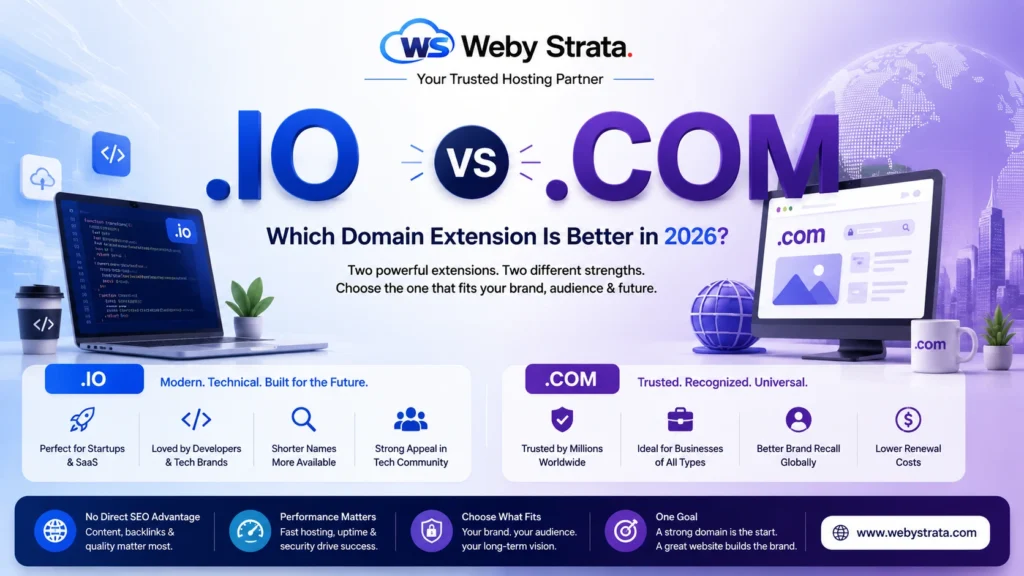
A domain name often stays with a business much longer than its logo, tagline, website design, or even its original business model. Companies redesign their websites, change their positioning, expand into new markets, and introduce new products, but the domain usually remains the constant identifier customers associate with the brand. That permanence is exactly why the .io vs .com decision deserves more consideration than simply checking which domain name is available.
For startups, SaaS companies, developer platforms, technology businesses, gaming companies, and digital products, .io has developed a particularly strong identity. It has become closely associated with software and internet-based products, even though its original purpose had nothing to do with technology. On the other hand, .com remains the most universally recognized domain extension, with decades of familiarity behind it.
The choice therefore isn’t simply about which extension looks more modern. A business needs to consider how customers will perceive the domain, whether the name is easy to remember, how much flexibility the business needs as it grows, what domain names are actually available, and whether the extension fits the audience the company is trying to reach.
This guide looks at .io vs .com from a practical business perspective, including branding, SEO, availability, audience perception, technical businesses, ecommerce, long-term growth, and the trade-offs that come with choosing each extension.
What Is a .io Domain?
The .io domain was originally assigned as the country-code top-level domain for the British Indian Ocean Territory. Its popularity in the technology industry did not come from that geographic meaning. Instead, developers and technology companies gradually adopted the two-letter extension because “I/O” is a familiar abbreviation for input/output, a fundamental concept in computing.
That connection was particularly appealing to developers and technology companies. As startups began using .io domains for software products, developer tools, SaaS platforms, gaming projects, and online applications, the extension developed a new identity that went far beyond its original geographic purpose.
Over time, .io became associated with the startup ecosystem. A technology company using a .io address can immediately appear to belong to the software and digital-product world, even before a visitor has read the company’s website.
This association is one of the biggest reasons founders continue to consider .io when naming a new product.
A .io domain also gives businesses access to names that may no longer be available under .com. This is particularly valuable for startups that want a short brand name without adding unnecessary words, numbers, or hyphens.
The extension is therefore not simply an alternative to .com. For certain types of companies, it has become part of the brand positioning itself.
What Are the Branding Benefits of a .io Domain?
A domain extension contributes to the first impression a visitor forms about a company. The effect isn’t necessarily conscious. People often make assumptions about a website based on its name before they know anything else about the business.
For a technology-focused brand, .io can reinforce the idea that the company belongs to the software ecosystem.
Technical Brand Recognition
Developers, engineers, technology professionals, and early adopters are already familiar with .io. The extension can therefore create an immediate association with software and technology.
A product such as a developer platform, API service, cloud application, or coding tool can feel naturally aligned with a .io domain.
More Opportunities for Short Names
The .com namespace is highly competitive, particularly for short and memorable words. Businesses searching for a modern brand name may find considerably more possibilities with .io.
That can be valuable during the early stages of building a startup, when the founder wants the domain, product name, social handles, and overall identity to remain consistent.
Strong Startup Association
Over the years, .io has become strongly connected with startups and technology companies. This gives the extension a particular positioning that .com doesn’t necessarily provide.
A .com domain can represent almost anything. A .io domain often gives the visitor a subtle indication that the company may be technology-focused.
Flexible for Digital Products
A .io domain doesn’t force a business into one particular product category.
A company can begin with a developer tool, move into SaaS, introduce an API, or expand into a broader software platform without the domain becoming outdated.
Where Does a .io Domain Work Best?
The extension is particularly natural for businesses whose customers are already comfortable with technology.
SaaS platforms, developer tools, API providers, cloud applications, gaming companies, software startups, AI products, cybersecurity companies, and technology communities can all build a strong identity around .io.
For these businesses, the extension can feel like part of the product rather than simply a domain suffix.
A developer who sees something like product.io is unlikely to find the extension unusual. In fact, it may reinforce the expectation that the website belongs to a technology product.
That perception becomes less useful when the target audience is primarily non-technical consumers.
A family restaurant, local retail store, healthcare clinic, or traditional professional service business may not gain much from the technology association of .io. In such cases, .com may communicate the business identity more naturally.
What Is a .com Domain?
The .com domain has been one of the defining components of the commercial internet since its earliest years. Originally created for commercial organizations, it eventually became much broader than its original purpose.
Today, .com is used by businesses, startups, ecommerce stores, service providers, publishers, creators, organizations, and companies of almost every size.
Its greatest strength is familiarity.
Most internet users have encountered .com websites thousands of times. When someone hears a business name and wants to visit its website, they may instinctively assume that the address ends in .com.
That behavior has created a level of recognition that newer extensions cannot easily replicate.
A .com domain doesn’t need to explain itself. Customers already know what it is.
This becomes particularly valuable for businesses that want to reach a broad audience rather than a specific technology community.
What Are the Branding Benefits of a .com Domain?
The value of .com is closely connected to the amount of trust and recognition accumulated over decades.
Universal Recognition
A .com domain is immediately familiar to customers across different industries and markets.
Whether someone is visiting an ecommerce website, a consulting company, a software business, or a local service provider, they already understand what the extension represents.
Strong Brand Recall
People often remember .com automatically because it has become the default website extension in their minds.
This can be particularly useful for offline marketing. If someone hears a company name on the phone, at an event, or through word of mouth, they are more likely to know what extension to try.
Established Business Perception
A .com address can create a conventional and established impression, particularly for companies that want to position themselves as long-term businesses rather than experimental projects.
Broad Industry Flexibility
Unlike .io, .com doesn’t create a strong expectation about what the business does.
That flexibility can be valuable if the company changes direction, introduces new services, or expands into industries that are unrelated to its original product.
A company can start as a software business and later move into consulting, education, hardware, or professional services without the domain feeling out of place.
.com vs .io: Which Sounds Better?
Domain names have a surprisingly strong effect on how a brand feels.
The difference becomes obvious when you say the extensions out loud.
A name ending in .io often sounds short, technical, and modern. It naturally fits products designed for developers, engineers, startups, and technology enthusiasts.
A name ending in .com sounds more familiar and complete. It carries a broader commercial identity and doesn’t immediately narrow the audience.
Consider a hypothetical developer platform called: Deploy.io
The name feels technical and product-oriented. It sounds like something a software engineer might use every day.
Now consider a traditional retail business using: FreshBakery.io
The extension creates a different impression. A visitor might initially assume the website belongs to a technology platform rather than a bakery.
The same business using: FreshBakery.com feels much more natural.
This is why the question isn’t simply “Which extension is better?”
The better question is: Which extension makes sense for the business you’re building?
SEO Impact: Does .io or .com Rank Better?
SEO is one of the first concerns businesses raise when comparing domain extensions.
The important point is that neither .io nor .com provides an automatic ranking advantage simply because of the extension.
Search engines evaluate a much broader set of signals when determining where a website should appear in search results.
The quality and relevance of the website’s content, technical SEO, backlinks, website performance, internal linking, mobile experience, search intent, and overall authority all have a much greater impact on organic visibility.
A well-optimized .io website can rank successfully.
A well-optimized .com website can rank successfully.
Likewise, a poorly optimized website can struggle regardless of whether it uses .io or .com.
The domain extension should therefore be selected based on brand positioning, audience, availability, and long-term strategy, rather than an assumption that one extension automatically performs better in search.
Content Quality Matters More
If a technology company wants organic traffic, creating useful technical content, documentation, product guides, tutorials, and resources will have far more impact than switching between .io and .com.
Backlinks Matter More
Relevant links from authoritative websites can contribute significantly to search visibility. A domain extension doesn’t replace the need to build website authority.
Technical Infrastructure Matters More
Website speed, server performance, uptime, SSL, caching, mobile responsiveness, and technical implementation can directly affect the quality of the user experience.
This is one reason businesses need to look beyond the domain when building their online infrastructure. A strong domain paired with unreliable hosting is still a weak digital foundation.
Related Read: .io vs .com: Which Domain Extension Is Better in 2026?
How Do .io and .com Compare Side by Side?
The practical differences are mostly related to branding, audience expectations, and availability rather than the technical capability of the website.
| Factor | .io | .com |
|---|---|---|
| Brand tone | Technical, modern | Universal, established |
| Best suited for | Startups, SaaS, developers, technology | Businesses across industries |
| Audience perception | Innovative, technology-focused | Familiar, trustworthy, mainstream |
| Availability | More opportunities for short names | Highly competitive |
| Global recognition | Strong within technology | Extremely broad |
| Business flexibility | Excellent for digital products | Excellent across industries |
| SEO advantage | No inherent advantage | No inherent advantage |
| Best fit | Technology-focused brands | Broad consumer and business brands |
This comparison makes one thing clear: the two extensions aren’t competing on exactly the same ground.
.io has a stronger technology identity.
.com has a stronger universal identity.
The decision should be based on which of those characteristics is more valuable to your business.
Which Extension Offers Better Domain Availability?
Availability is where the comparison becomes very practical.
Finding a short and memorable .com domain can be difficult because many of the obvious names have already been registered.
Businesses may encounter three possibilities when searching for a .com:
The name is available at normal registration pricing.
The name is registered and unavailable.
The name is registered but may be available through a premium domain sale.
For a startup operating with a limited budget, the third option may not be attractive.
This is where .io can provide additional opportunities.
A founder may find a short technology-oriented brand available under .io even though the corresponding .com is already registered.
That can allow the company to preserve the brand name instead of adding unnecessary words.
However, domain availability should never be the only reason to choose .io.
A domain that is available but difficult to pronounce, spell, or remember is not automatically a good domain.
The goal is to find a strong brand name with a suitable extension, not simply an available domain.
What Is the Keyword and Relevance Advantage?
Neither .io nor .com provides a direct keyword ranking advantage.
Search engines don’t simply see a technology-related extension and decide that the website deserves a higher ranking for technology searches.
However, the domain can still influence how users interpret a search result.
A recognizable and relevant brand name can help a searcher understand what kind of company they’re looking at before clicking.
For example, a technology product using a concise .io domain may immediately look like a software product to a developer.
That doesn’t directly increase rankings, but it can contribute to the overall perception of the result.
The distinction is important:
Domain relevance can influence human perception, but it is not a substitute for SEO.
Your website still needs useful content, strong technical implementation, authority, and a good user experience.
How Does Audience Affect the .io vs .com Decision?
Your target audience should play a major role in the decision.
A technology audience is already familiar with .io. Developers, engineers, startup founders, product managers, and technology enthusiasts encounter .io domains frequently.
For them, the extension may even strengthen the brand.
A general consumer audience is different.
A customer searching for a local business or ecommerce store may be more accustomed to .com. They may not think about the technical meaning behind .io and may simply assume the website should end in .com.
This doesn’t mean consumers won’t use .io.
It simply means that the extension should match the expectations of the people you’re trying to reach.
If the audience is technical, .io can feel natural.
If the audience is broad and non-technical, .com may reduce friction.
What Are the Trade-Offs Between .io and .com?
Every domain decision involves compromises.
.io
The biggest advantage is its strong technology identity combined with better availability for certain short, brandable names.
That makes it attractive for startups, SaaS products, developer tools, gaming companies, and digital products.
The trade-off is that .io is not as universally familiar as .com. A technology professional may immediately understand it, while a general consumer may be less accustomed to the extension.
Businesses should also evaluate the current and long-term registration and renewal pricing before committing to a domain. Pricing can vary by registrar and domain name, so the initial registration price should never be the only consideration.
.com
The biggest advantage of .com is its universal recognition.
Customers already know the extension, businesses across industries use it, and the domain can remain relevant even if the company changes direction.
The main drawback is availability.
Short, memorable .com names are highly competitive, and desirable names can sometimes require premium pricing.
That can make .com less accessible to startups that want a particular brand name but don’t have a large domain acquisition budget.
.io vs .com for Startups
Startups often face the domain decision at the same time they’re developing their product, choosing their company name, creating a logo, and preparing to enter the market.
At that stage, .io can be particularly attractive.
A startup may want a short name that sounds modern and technical. If the .com is already taken, .io can provide a way to maintain the original brand.
For a developer-focused SaaS company, the extension can actually reinforce the company’s positioning.
For example, a product called: BuildStack.io
immediately feels like a technology product.
The same name under .com would also work, but the .io version creates a stronger technical association.
However, founders should think beyond the current startup stage.
If the company eventually becomes a broad consumer business, expands into professional services, or moves into an industry where the technology association is less relevant, .com may provide greater flexibility.
.io vs .com for SaaS Companies
SaaS businesses are one of the strongest use cases for .io.
A SaaS product is fundamentally digital, and the audience is often already comfortable with modern domain extensions.
The .io identity can therefore become part of the product’s positioning.
For a developer platform, analytics product, API provider, cybersecurity tool, or cloud application, .io can feel highly appropriate.
At the same time, a SaaS company targeting non-technical consumers may benefit more from the familiarity of .com.
The extension should therefore reflect the actual audience, not simply the technology used to build the product.
.io vs .com for Ecommerce
For ecommerce businesses, .com generally has a stronger advantage.
Online shoppers are accustomed to seeing .com domains, particularly when purchasing products or submitting payment information.
Trust and familiarity matter significantly during the buying process.
A technology startup can use .io without customers questioning the domain because the audience expects innovation.
An ecommerce company needs to think more carefully about whether its customers will immediately recognize and trust the extension.
This doesn’t mean ecommerce businesses cannot use .io. It simply means the branding needs to compensate for the lower familiarity among general consumers.
For businesses where customer trust and mainstream recognition are central to the buying process, .com remains a strong option.
Should You Register Both .io and .com?
If your preferred brand name is important to the business and both extensions are available, registering both can be a sensible brand protection strategy.
For example: yourbrand.com and yourbrand.io
You can select one as your primary website and redirect the other to it.
This allows the business to protect the brand across both extensions while avoiding the complexity of maintaining two separate websites.
For technology companies, owning both can be particularly useful.
The .io domain can be used for the product or technology identity, while the .com version can protect the broader corporate brand.
The exact strategy depends on the business, but registering the alternative domain early can be considerably easier than trying to acquire it after the brand becomes valuable.
What Should You Check Before Registering a .io or .com Domain?
Don’t make the decision based purely on registration price or availability.
Think about the name as a long-term business asset.
The domain should be easy to spell, easy to pronounce, easy to remember, and suitable for the audience you’re targeting.
You should also check the availability of the corresponding brand name on important social platforms. A consistent brand identity across the website and social media can make marketing significantly easier.
Trademark research is equally important. A domain being available does not necessarily mean the brand name is safe to use commercially.
Finally, check the renewal price rather than looking only at the introductory registration price. Domain pricing can vary significantly depending on the extension, registrar, and whether a name is classified as premium.
What About Long-Term Business Growth?
This is where founders need to think beyond the current website.
Your business may look completely different five years from now.
A startup may begin as a developer tool and later become an enterprise software company.
An ecommerce company may begin with one product category and eventually expand into multiple markets.
A service company may transform into a software platform.
The domain needs to remain relevant throughout that evolution.
This is one reason .com remains attractive. It doesn’t strongly define what the company does.
A .io domain can be more powerful when technology is central to the brand, but it can also create a stronger association with technology.
That isn’t necessarily a disadvantage. It simply means the decision should be deliberate.
Final Insights
The .io vs .com decision is ultimately about fit rather than finding a universal winner.
A technology product built for developers, engineers, gamers, SaaS users, or early adopters can benefit from the identity that .io has developed. The extension feels modern, technical, and closely connected with the startup ecosystem. If the matching .com is unavailable, .io can also provide valuable opportunities for securing a short and memorable brand name.
For businesses targeting a broad consumer audience, ecommerce customers, professional clients, or international markets where immediate familiarity matters, .com remains the stronger default choice. Its recognition has been built over decades, and customers generally don’t need any explanation when they see a .com website.
Neither extension gives a website an automatic SEO advantage. Search visibility comes from the quality of the website behind the domain—its content, relevance, authority, technical performance, and user experience.
The best approach is therefore not to choose an extension because it is trending or because someone claims it will rank better.
Choose the extension that makes sense for the business, the audience, and the future direction of the brand.
If the exact .com domain is available and fits your business, it is difficult to argue against securing it. If the .com is unavailable and you’re building a technology-focused company, a strong .io domain can be an excellent alternative.
And when both are available, protecting both can be a smart long-term branding decision.
At WebyStrata, the domain is only the beginning. A strong online presence also depends on reliable hosting, performance, security, backups, and infrastructure that can support the business as it grows.
Originally published on WebyStrata.com Blog.