Startup
Private Limited Company vs LLP vs OPC vs Sole Proprietorship: Which Is Best for Your Business in India?
Compare Private Limited Company, LLP, OPC, partnership, and sole proprietorship structures to choose the right business registration option in India.
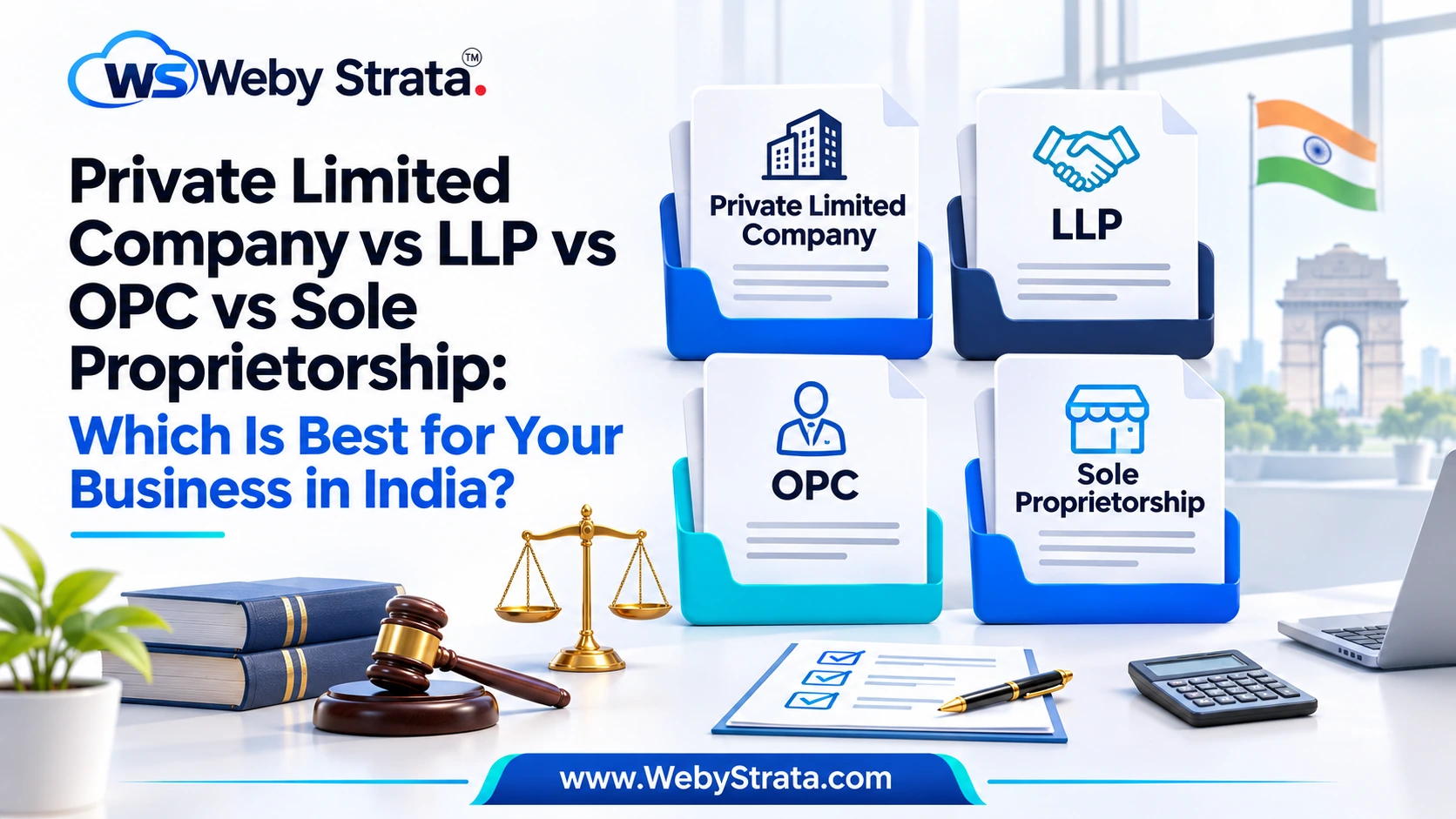
Choosing the right legal structure is one of the most important decisions when starting a business in India. The structure you select can affect liability, taxation, compliance, ownership, funding, banking, and future growth.
There is no single business structure that is best for everyone. A freelancer may prefer a proprietorship, while a growing agency may choose an LLP. A business seeking investors may require a Private Limited Company, while a solo entrepreneur may consider an OPC.
Quick comparison
| Structure | Best suited for | Liability | Funding flexibility | Compliance level |
|---|---|---|---|---|
| Private Limited Company | Growing businesses and investment-focused companies | Limited | High | Higher |
| LLP | Partner-led agencies and professional firms | Limited | Moderate | Moderate |
| OPC | One-person businesses seeking a corporate structure | Limited | Limited | Moderate |
| Partnership Firm | Small businesses with trusted partners | Generally unlimited | Limited | Lower |
| Sole Proprietorship | Individual and low-risk businesses | Generally unlimited | Low | Lower |
Private Limited Company
A Private Limited Company may be suitable for businesses that plan to scale, raise external investment, add shareholders, or work with larger clients.
Advantages
- Separate legal identity
- Limited liability for shareholders
- Easier ownership through shares
- Better suited to external equity investment
- Suitable for larger teams and long-term expansion
- Can improve credibility with banks and institutional clients
Limitations
- Greater reporting and compliance responsibilities
- More formal decision-making requirements
- Higher professional and accounting costs
- Annual filings and statutory records must be maintained
- Ownership changes require proper documentation
A Private Limited Company is often appropriate for technology companies, product businesses, funded startups, manufacturers, and companies planning significant expansion.
Limited Liability Partnership
An LLP combines partnership-style management with limited liability. It may suit agencies, consulting firms, professional practices, and service businesses operated by two or more partners.
Advantages
- Limited liability for partners
- Flexible profit-sharing arrangements
- Partner responsibilities can be defined in the LLP agreement
- Suitable for professional and service businesses
- Generally simpler management than a company
- Useful where partners do not need shareholder-based investment
Limitations
- Not as convenient as a company for issuing equity shares
- Investment structures may be more complicated
- Partners must maintain proper records and complete applicable filings
- The LLP agreement must be carefully drafted
- Changes in partners and responsibilities must be documented
An LLP may be a strong choice for digital agencies, accounting firms, consulting firms, design studios, and professional partnerships.
One Person Company
An OPC may be considered by one entrepreneur who wants a corporate structure while operating alone.
Advantages
- Separate legal identity
- Limited liability
- Suitable for a single business owner
- Can create a more formal business identity
- Helps separate personal and business affairs
Limitations
- Designed around a single member
- Additional rules may apply to nominee and conversion matters
- Less flexible if multiple shareholders are expected soon
- Professional compliance may cost more than a proprietorship
- External investment can be less flexible than in a Private Limited Company
An OPC may suit a solo consultant, independent professional, small product business, or individual service provider who wants more structure than a proprietorship.
Partnership Firm
A partnership firm is operated by two or more people under a partnership deed.
Advantages
- Simple operating structure
- Flexible internal arrangements
- Lower setup complexity in many cases
- Suitable for small businesses with trusted partners
- Partnership responsibilities can be defined contractually
Limitations
- Partners may have personal liability for business obligations
- Disagreements can affect business operations
- Investment and ownership changes may be less flexible
- The partnership deed must clearly define authority and profit sharing
- State-level registration and licensing requirements may apply
A partnership firm may work for a small family business or closely held business where the partners understand and accept the associated risks.
Sole Proprietorship
A sole proprietorship is owned and controlled by one individual. It is commonly used by freelancers, small traders, home businesses, and individual service providers.
Advantages
- Simple ownership and decision-making
- Lower operating complexity
- Direct control over income and business decisions
- Suitable for testing a small or low-risk business
- Fewer internal management formalities
Limitations
- No separate legal identity from the owner
- The owner may be personally responsible for business debts and claims
- Limited funding options
- May be less suitable for large contracts or institutional clients
- Additional registrations may be required depending on the activity and location
A proprietorship may be suitable at the beginning, but the owner should review the structure as revenue, employees, contracts, and business risks increase.
Key differences between Pvt Ltd and LLP
The main difference is how ownership and investment are organized.
A Private Limited Company uses shareholders and shares. This structure is generally more suitable when the business expects external equity investment, multiple owners, employee ownership plans, or major expansion.
An LLP uses partners and an LLP agreement. This structure can be more flexible for partner-led businesses where profits, responsibilities, and decision-making need to be customized.
Which structure is best for your business?
Choose a Private Limited Company if:
- You plan to raise equity investment
- You expect to add shareholders
- You are building a scalable product or technology business
- You want a formal corporate structure
- You may offer employee stock or ownership incentives
- You expect larger contracts or institutional customers
Choose an LLP if:
- Two or more partners will operate the business
- The business is service-based
- Partners want flexible profit sharing
- External equity investment is not an immediate priority
- The founders want limited liability with partner-led management
Choose an OPC if:
- You are the only owner
- You want limited liability
- You want a formal corporate identity
- You do not expect to add shareholders immediately
Choose a sole proprietorship if:
- You are testing a small business idea
- The business has relatively low risk
- You want simple management
- You do not need external investors
- You are operating as an individual freelancer or trader
Choose a partnership firm if:
- The business has two or more trusted owners
- The partners want a simple operating model
- The business does not require complex investment
- The partners are prepared to define responsibilities clearly
Questions to ask before choosing
- How many owners will the business have?
- Will you need outside investment?
- Can the owners accept personal liability?
- How much compliance can the business manage?
- Will the business sign large contracts?
- Will ownership change in the future?
- Will you hire employees?
- Does the business need sector-specific licences?
- Will you operate in multiple states?
- Do you need a separate corporate identity?
Common mistakes to avoid
- Choosing a structure only because it is inexpensive
- Registering a Private Limited Company without understanding ongoing compliance
- Operating a risky business as a sole proprietorship
- Using an LLP without a detailed agreement
- Failing to define partner roles and profit sharing
- Ignoring future funding and ownership requirements
- Not reviewing the structure as the business grows
- Assuming registration automatically covers all licences and tax requirements
Frequently asked questions
Is an LLP better than a Private Limited Company?
Neither is automatically better. An LLP may suit partner-led service businesses, while a Private Limited Company may suit businesses seeking shareholders, equity investment, and significant growth.
Is an OPC suitable for every solo entrepreneur?
No. An OPC may suit a solo entrepreneur who wants a corporate structure, but a proprietorship may be simpler for a small, low-risk business.
Does a sole proprietorship require registration?
A proprietorship does not have the same central incorporation process as a company or LLP. However, the business may require tax, local, trade, or sector-specific registrations.
Can an LLP raise investment?
An LLP can receive investment, but its ownership and investment structure is different from a company that issues shares. Businesses expecting equity investment should evaluate this carefully.
Can a business change its legal structure later?
In some cases, a business can convert or reorganize into another structure. The process, tax treatment, approvals, and documentation depend on the existing and proposed structures.
Final thoughts
The best business structure is the one that matches your ownership, risk, funding plans, compliance capacity, and growth objectives.
A proprietorship may be practical for a small individual business. An LLP may suit a partner-led agency or professional firm. An OPC may suit a solo entrepreneur seeking limited liability, while a Private Limited Company may be more appropriate for a scalable business seeking investment.
Before registering, review the decision with a qualified Company Secretary, Chartered Accountant, or legal professional. This article provides general information and should not replace professional legal, tax, or compliance advice.
Related Articles