Domain
.Store vs .Shop – Key Differences, SEO Impact & Best Choice Explained
.Store vs .Shop Explained: Almost every new ecommerce business reaches the same problem sooner or later: the perfect .com domain name is already taken. Instead of changing a strong brand name, adding unnecessary…
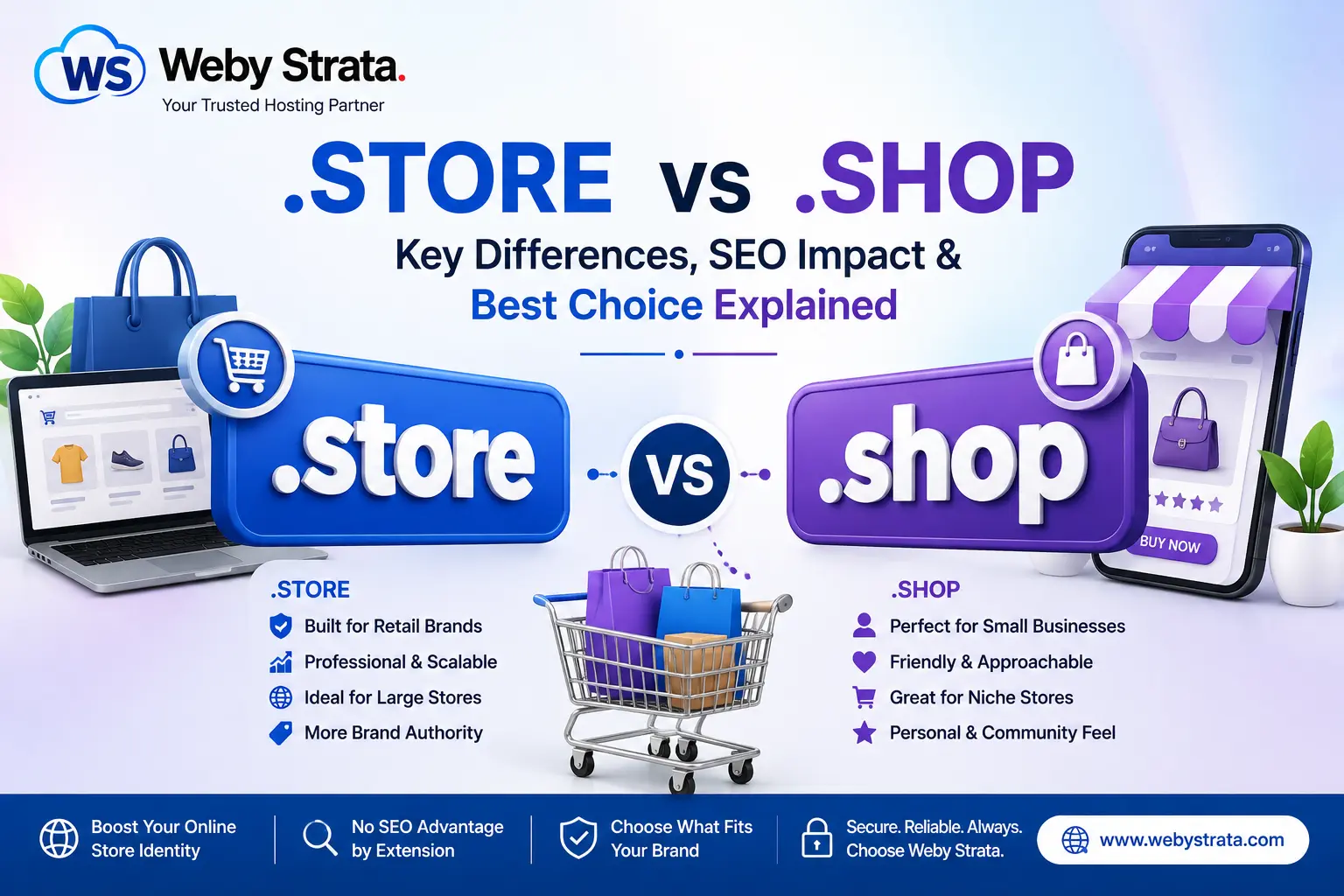
.Store vs .Shop Explained:
Almost every new ecommerce business reaches the same problem sooner or later: the perfect .com domain name is already taken. Instead of changing a strong brand name, adding unnecessary words, or choosing a long and difficult domain, businesses now have more specialized options that clearly communicate what they do.
Two of the most popular ecommerce-focused extensions are .store and .shop.
Both domain extensions are designed for businesses selling products online, but they create slightly different impressions. A .store domain generally feels more like an established retail business with a broader product offering, while .shop often sounds more approachable, direct, and customer-focused.
That difference may appear minor, but domain names are part of your brand identity. Customers see them in advertisements, social media profiles, email addresses, packaging, and search results. The right extension can make your business easier to understand and remember, while the wrong choice can create unnecessary confusion.
So, which one should you choose?
Does .store or .shop have an SEO advantage? Which extension is better for ecommerce? Is .store more professional than .shop? Does .shop work better for startups and small businesses?
In this guide, we’ll compare .store vs .shop in detail, covering branding, customer perception, domain availability, SEO, ecommerce use cases, potential drawbacks, and long-term business considerations so you can choose the extension that fits your online store.
If you want a domain that communicates a professional, established, and scalable retail identity, .store is generally the stronger choice. It works particularly well for ecommerce businesses that sell multiple product categories or plan to expand their product range over time.
If you’re building a small, niche, founder-led, or approachable online business, .shop can feel more natural. The word “shop” is conversational and directly communicates the action of buying products online.
From an SEO perspective, neither extension has an automatic ranking advantage. Google does not simply rank a .store domain above a .shop domain because of the extension.
The better choice therefore depends primarily on your brand positioning, audience, domain availability, and long-term business plans.
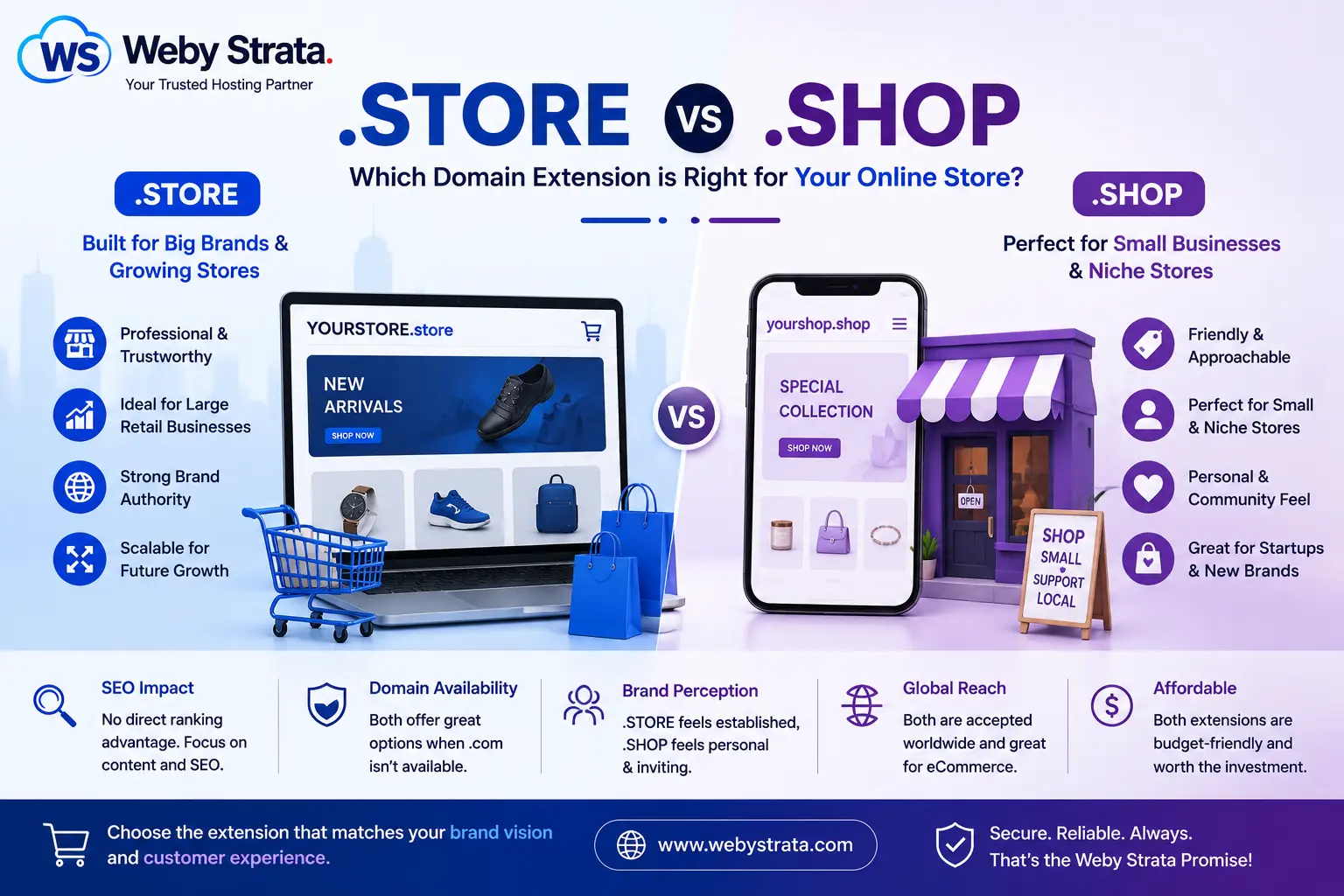
What Is a .Store Domain?
The .store domain is a generic top-level domain specifically associated with retail and ecommerce. Unlike .com, which can represent almost any type of website, .store immediately communicates a commercial purpose.
When a customer sees an address such as:
yourbrand.store
they can reasonably expect the website to sell products.
That immediate context can be useful for ecommerce businesses. You don’t need to explain what the website is through the domain itself because the extension already establishes a retail connection.
The extension is particularly useful for businesses that couldn’t secure their preferred .com domain but still want a short and meaningful web address.
For example, if a fashion brand wants to use a particular name and the .com version is unavailable, a .store domain can preserve the brand while making the website’s commercial purpose clear.
The extension also provides room for businesses to grow. A company may begin by selling clothing and later expand into accessories, footwear, beauty products, or lifestyle products without the domain becoming too narrow.
What Are the Branding Benefits of a .Store Domain?
A .store domain can influence how customers perceive a business before they even reach the website.
Instant Ecommerce Clarity
One of the strongest advantages is that the extension immediately communicates that the website is a place to buy products.
A visitor doesn’t need to understand what the company does before clicking. The domain itself provides a clear clue.
Professional Retail Positioning
The word “store” tends to sound established and commercial. It can work particularly well for brands that want to create the impression of a serious retail operation rather than a temporary online project.
Suitable for Business Expansion
A .store domain isn’t limited to one specific product category. A business can expand its catalog without the domain becoming irrelevant.
A fashion retailer can add accessories. An electronics business can expand into appliances. A beauty company can add skincare and wellness products.
Easier to Find a Brandable Domain
The traditional .com namespace is crowded. A .store extension gives businesses another opportunity to secure a short and recognizable domain.
Strong Commercial Intent
The extension itself communicates that customers can expect products, shopping, and transactions on the website.
Consistent Global Identity
Unlike country-specific domain extensions, .store doesn’t immediately associate a business with one particular geographic market. This makes it suitable for ecommerce businesses targeting customers across multiple countries.
What Is a .Shop Domain?
The .shop domain is another generic top-level domain designed around online shopping and retail.
The word “shop” has a slightly different tone from “store.” While store can sound more established and business-oriented, shop tends to feel more conversational and approachable.
Think about the difference between saying:
Visit our store
and
Shop with us
The first sounds like a physical retail destination. The second feels more direct and customer-focused.
This makes .shop particularly attractive to smaller ecommerce businesses, independent brands, creators, handmade product sellers, and businesses that want a friendly identity.
A .shop domain can also work well when the business is testing a new product category or building a niche ecommerce brand.
What Are the Branding Benefits of a .Shop Domain?
Friendly First Impression
The word “shop” feels familiar and conversational. Customers immediately understand its commercial purpose without the extension sounding overly corporate.
Strong Fit for Small Businesses
Independent businesses and founder-led ecommerce brands can benefit from the approachable nature of .shop.
Excellent for Niche Brands
A handmade jewelry business, custom clothing brand, specialty food company, or independent beauty business can naturally fit the tone of a .shop domain.
Easy to Say and Remember
“Shop” is a common everyday word. Customers are unlikely to struggle with pronunciation or spelling.
Community-Oriented Branding
Businesses that emphasize personal relationships, handmade products, local customers, or founder stories can find the word “shop” more natural than “store.”
Good for New Ecommerce Ideas
A new business testing a product category can use .shop without creating the impression that it already operates as a large-scale retail organization.
.Store vs .Shop: Detailed Comparison
The biggest difference between the two extensions is brand perception, not technical functionality.
| Feature | .Store | .Shop |
|---|---|---|
| Brand Tone | Professional and established | Friendly and approachable |
| Best For | Growing and established ecommerce brands | Small, niche and founder-led businesses |
| Customer Perception | Retail-focused and serious | Personal and conversational |
| Ecommerce Relevance | Very strong | Very strong |
| Brand Flexibility | Excellent for expansion | Strong for focused businesses |
| Memorability | High | Very high |
| Global Use | Strong | Strong |
| SEO Advantage | None inherent | None inherent |
| Best Positioning | Retail and ecommerce | Shopping and direct-to-consumer |
Neither extension is technically superior. The decision comes down to how you want your business to be perceived.
.Store vs .Shop: Which Sounds Better for Ecommerce?
The difference becomes easier to understand when you think about customer expectations.
A .store domain tends to communicate scale. It can make customers imagine a broader product catalog, established operations, and a traditional retail business.
A .shop domain feels more direct. It suggests an invitation to shop rather than simply identifying the website as a store.
For example, a large ecommerce brand selling hundreds of products across multiple categories may naturally fit a .store domain.
A small handmade candle company, independent clothing label, or specialty food business may feel more authentic using .shop.
Neither approach is inherently better. The right option depends on the story your brand wants to tell.
When Should You Choose a .Store Domain?
A .store domain is particularly suitable when your ecommerce business is designed for long-term growth.
For Established Ecommerce Brands
If your business already has a broad product catalog and wants to present itself as a serious retail operation, .store can reinforce that positioning.
The extension makes the commercial purpose of the website immediately clear while maintaining a professional appearance.
For Businesses Planning to Expand
If you expect to add more product categories in the future, .store gives you plenty of flexibility.
The domain doesn’t lock your business into a particular product.
When Your .com Is Unavailable
If your preferred brand name is already registered under .com, .store can provide a clean alternative without forcing you to change your brand.
For Premium Retail Branding
Businesses that want to position themselves as established, polished, and commercially focused may find .store more appropriate.
When Should You Choose a .Shop Domain?
A .shop domain can be particularly effective when your brand is built around accessibility and personal connection.
For Small Online Businesses
If you’re starting a small ecommerce business, .shop can immediately communicate what your website does without making the company appear larger than it is.
For Handmade and Independent Brands
Businesses selling handmade products, customized items, artwork, jewelry, candles, clothing, or specialty products can benefit from the approachable tone of .shop.
For Founder-Led Businesses
If the brand story centers around the person behind the business, .shop can create a more personal impression.
For Niche Ecommerce Stores
Businesses focused on a particular product category can use .shop to establish a clear shopping identity without sounding overly corporate.
SEO Impact: Does .Store or .Shop Rank Better?
This is one of the most important questions businesses ask before choosing a domain extension.
The short answer is no.
Neither .store nor .shop receives an automatic ranking advantage simply because it is related to ecommerce.
Search engines evaluate the overall quality and relevance of the website rather than giving a direct ranking boost to one ecommerce-oriented extension.
A website using .store can rank well.
A website using .shop can rank well.
A .com ecommerce website can also rank well.
The extension itself isn’t the factor that determines whether a product page appears on the first page of Google.
What matters much more is what you build around the domain.
Content Quality Matters More
Your product descriptions, category pages, buying guides, blog content, and other website resources should provide useful information that matches what customers are searching for.
A descriptive domain cannot compensate for thin or unhelpful content.
Backlinks Carry More Weight
Relevant backlinks from reputable websites can contribute significantly to search visibility.
A strong backlink profile is far more valuable from an SEO perspective than simply selecting .store instead of .shop.
Technical SEO Matters
Website speed, mobile responsiveness, crawlability, internal linking, structured data, canonical URLs, and clean site architecture all play important roles in ecommerce SEO.
User Experience Matters
An online store needs to be fast, easy to navigate, secure, and convenient to use.
A customer who lands on a slow website and struggles to find products isn’t going to have a good experience regardless of whether the domain ends in .store or .shop.
This is where reliable hosting becomes important. Fast server infrastructure, caching, optimized databases, security, backups, and dependable uptime contribute to the overall technical foundation of an ecommerce website.
What Is the Keyword and Relevance Advantage?
Although .store and .shop don’t provide a direct ranking advantage, they can provide contextual relevance to users.
Imagine a customer sees:
brandname.store
or
brandname.shop
The extension itself suggests that the website is related to shopping or retail.
This can make the domain easier to understand before the visitor reaches the website.
That distinction is important.
A domain extension may influence user perception and click behavior, but that doesn’t mean Google gives the extension an automatic ranking boost.
In other words, .store and .shop can help communicate commercial intent, but your website still needs strong content and SEO to compete in search results.
Domain Availability: Why Are Ecommerce Brands Choosing .Store and .Shop?
The availability of attractive domain names is one of the biggest reasons businesses consider newer extensions.
The most obvious .com names have been registered for years. A new ecommerce business may discover that its preferred brand name is unavailable under .com.
Changing the brand name isn’t always practical.
The business may already have:
- A registered company name
- A logo
- Packaging
- Social media accounts
- Marketing materials
- Product labels
- Customer recognition
Using .store or .shop can allow the business to retain its brand identity while selecting an extension that actually fits the business.
This is one of the strongest arguments for industry-specific domains.
Instead of trying to force an ecommerce brand into an available but unrelated domain name, you can choose an extension that communicates what the business does.
.Store vs .Shop for Branding
The right extension should complement the personality of your brand.
A .store domain tends to sound more established and retail-focused. It can work well for companies that want customers to perceive them as a serious ecommerce operation.
A .shop domain feels more personal and conversational. It can work particularly well for brands where the shopping experience is closely connected to the founder, community, or product story.
Consider two hypothetical businesses.
UrbanTech.store sounds like a technology retailer with a broader product catalog.
HandmadeByMaya.shop sounds more like an independent business where customers are buying directly from the person behind the products.
Both can be effective.
The important thing is that the extension should match the brand personality rather than simply being selected because it happens to be available.
Potential Drawbacks and Challenges to Consider
While .store and .shop offer clear benefits, businesses should also understand their limitations.
Some Customers Still Expect .com
Internet users have spent decades becoming accustomed to .com domains. Some people may automatically type .com even after seeing a different extension in an advertisement.
This doesn’t make .store or .shop unusable, but it means consistent branding matters.
Your website address should be clearly displayed across your marketing materials so customers remember the complete domain.
Newer Extensions May Require More Brand Reinforcement
A .com domain often needs little explanation because people already recognize the extension.
With a newer extension, businesses may need to repeat the complete domain more frequently in advertising, packaging, social media, and email signatures.
Over time, this becomes less important as customers become familiar with the brand.
Email Authentication Is Still Important
Regardless of the extension you choose, professional email configuration is essential.
Your business should properly configure SPF, DKIM, and DMARC to improve email authentication and reduce the risk of messages being treated as suspicious or spam.
The extension itself isn’t a substitute for proper email security.
Some Platforms May Require Additional Verification
Certain third-party services, directories, advertising platforms, or payment systems may have additional verification requirements for less familiar domain extensions.
This is generally a manageable issue, but businesses should consider their entire technology stack before launching.
How to Choose Between .Store and .Shop
The decision becomes easier when you focus on the actual positioning of your business.
If you’re building a serious ecommerce operation with a broad catalog and long-term expansion plans, .store is likely the better fit.
If you’re building a smaller, niche, independent, or founder-led online business where friendliness and accessibility are important, .shop may fit the brand better.
You should also consider your domain name itself.
A short, memorable .shop domain is usually better than a long and complicated .store domain.
Likewise, a clean .store domain can be more valuable than a confusing .shop combination.
The extension is only one part of the domain. The complete domain name matters more than the extension in isolation.
Should You Register Both .Store and .Shop?
If your brand is important and both domains are available, registering both can be a useful brand protection strategy.
For example:
yourbrand.store
and
yourbrand.shop
You can choose one as your primary website and redirect the other to it.
This prevents another business from acquiring the alternative extension and potentially confusing customers.
You don’t necessarily need to operate two ecommerce websites. The second domain can simply redirect to the main store.
For established ecommerce brands investing heavily in advertising and customer acquisition, protecting multiple relevant domain extensions can be a sensible part of their digital brand strategy.
What Should You Consider Before Registering an Ecommerce Domain?
Before registering a .store or .shop domain, don’t focus only on availability.
Think about how the domain will work across your entire business.
Your domain should be:
- Easy to spell
- Easy to pronounce
- Easy to remember
- Relevant to your brand
- Suitable for future expansion
- Legally safe to use
- Consistent with your social media identity
You should also check trademark availability before committing to a name.
A domain being available does not automatically mean the corresponding business name can be used legally.
.Store vs .Shop: Which One Should You Choose?
If you’re still unsure, the following approach makes the decision straightforward.
Choose .store when your priority is a professional, established, scalable retail identity. It works especially well for ecommerce companies with multiple products, growing catalogs, and long-term expansion plans.
Choose .shop when your priority is a friendly, approachable, and customer-focused identity. It works particularly well for independent sellers, niche brands, handmade businesses, and founder-led ecommerce stores.
If both are available, compare the complete domain names rather than the extensions alone.
For example:
BrandName.store
may be better than
BrandName.shop
if the brand wants to appear more established.
But:
MyHandmade.shop
may feel more natural than
MyHandmade.store
if the business is built around a personal and community-focused brand.
The best choice is the one that feels natural when customers see, hear, and remember your brand.
Final Thoughts
The .store vs .shop decision is ultimately a branding decision as much as it is a domain registration decision.
Both extensions are highly relevant to ecommerce businesses and can help communicate commercial intent immediately. Neither has an automatic SEO advantage over the other, and neither can replace the fundamentals required to build a successful online store.
If you’re building a large, professional ecommerce business or expect to expand into multiple product categories, .store can provide a strong and scalable identity.
If you’re building a smaller, niche, independent, or founder-led business, .shop can create a warmer and more approachable impression.
Don’t choose an extension simply because it is cheaper or available. Look at the complete domain, your target customers, your branding strategy, and where you expect the business to be several years from now.
Most importantly, remember that your domain is only the starting point. A memorable domain needs to be supported by a fast website, reliable hosting, strong security, good ecommerce UX, high-quality content, and consistent SEO.
At WebyStrata, businesses can register ecommerce-friendly domain extensions and build their online stores on reliable hosting infrastructure designed to support performance, security, and long-term growth.
Also read: .Store vs .Shop – Key Differences, SEO Impact & Best Choice Explained
Related Articles